The short answer
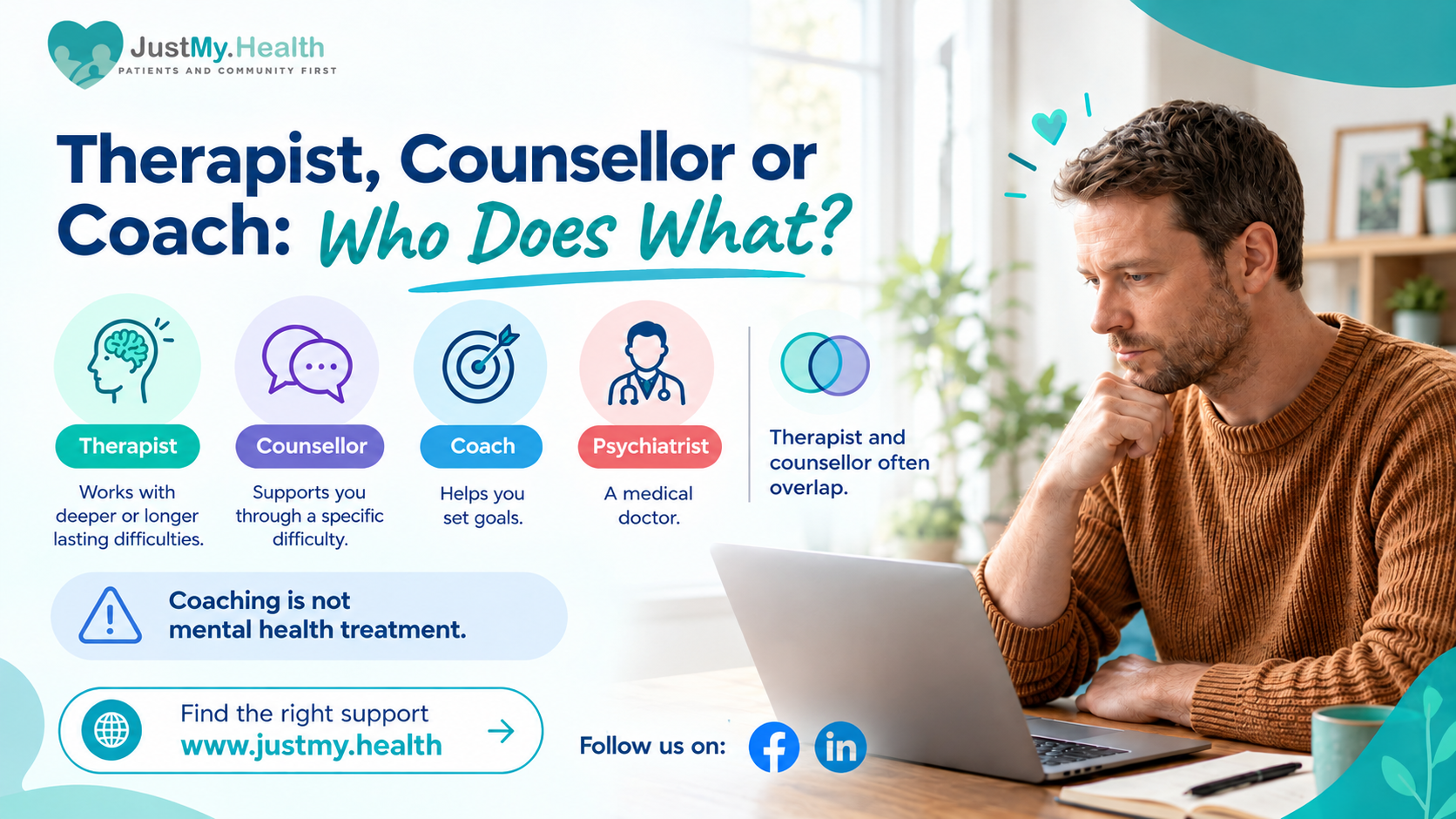
Therapists and counsellors support how you feel and cope. Coaches support where you're going. A psychiatrist is a medical doctor who can prescribe medication.
The three words are used interchangeably all the time, and the confusion can put people off getting help at all. This guide explains what each role does, who it might suit, and how to check that someone is properly qualified.
Therapist vs Counsellor vs Coach: The Roles at a Glance
Role
Best for
What it involves
Therapist
Deeper or longer lasting difficulties
Understanding and changing patterns, using recognised approaches
Counsellor
A specific difficulty
Talking it through and finding ways to cope
Coach
Goals, when life is okay
Direction, habits and accountability
Psychiatrist
Medical assessment and medication
Diagnosing conditions and prescribing treatment
These are typical differences. In practice, many qualified practitioners work as both, so look at their training and experience, not just their title.
What Is the Difference Between a Therapist and a Counsellor?
In general, a therapist works with deeper or longer lasting difficulties, often over a longer period, while a counsellor tends to focus on a specific issue, often in a shorter piece of work.
The two overlap, and many qualified practitioners work as both. Training also varies by course and country, so the title alone does not tell you how someone works. What tells you more is their training, their registration and their experience with what you are facing.
What Each Role Does
🧠
Therapist
Works with deeper or longer lasting difficulties, such as anxiety, low mood or old patterns that keep returning. Using recognised approaches over a series of sessions, a therapist helps you understand what is driving a difficulty and change it. This tends to suit you if something keeps getting in the way and you want to understand why.
💬
Counsellor
Supports you through a specific difficulty, such as stress, grief or a relationship problem. A counsellor gives you space to talk, feel heard and find ways to cope. This tends to suit you if you are dealing with a particular situation and want a safe place to work through it.
🚀
Coach
Looks forward, helping you set goals, build habits and stay accountable. Coaching suits you when life is broadly okay and you want more direction, confidence or a plan. Coaching is not mental health treatment, and a coach does not diagnose or treat conditions.
🩺
Psychiatrist
A medical doctor who can diagnose conditions and prescribe medication. A psychiatrist often works alongside a therapist, with one looking after medical treatment and the other providing talking therapy. This is the role people most often forget about.
You may also come across the titles psychologist and psychotherapist. These overlap with the roles above, and what they mean depends on the country you are in.
Three Examples
Here is how it might look in practice. These are illustrative examples, not real cases.
🍂
Anna has felt anxious for years, and the same patterns keep returning even when life is going well. She wants to understand why. A therapist is likely to suit her best.
🍂
Tom lost his father a few months ago and wants a safe place to talk through the grief. A counsellor is likely to suit him best.
🍂
Maya is doing okay, but wants a clearer direction in her career and someone to keep her on track. A coach is likely to suit her best.
Should I See a Coach or a Therapist?
If you are not sure, this simple guide can help. It is a guide, not a diagnosis.
Struggling most days, or the same patterns keep coming back?
→
Therapist or counsellor
Deeper patterns or a specific issue
Doing okay, but feeling stuck and want more direction?
→
Coach
Goals, habits and accountability
Think you may need medication or a medical assessment?
→
A doctor or psychiatrist
Medical assessment and medication
Still unsure? Our post How Do I Know When I Need Coaching or Therapy? goes into more detail.
Things Worth Knowing
🔍
Look beyond the title
Training, registration and experience tell you more about someone than the word on their profile does
🌍
Titles differ around the world
In some places these titles are regulated, and in others anyone can use them. That is why checking matters
⚠️
Coaching is not treatment
If you are struggling with your mental health, start with a therapist or counsellor. A coach can support your goals, but cannot take the place of treatment
How to Check Someone's Qualifications
A good professional will be glad to answer these questions. Before you begin, it helps to ask:
✓What training have you completed?
✓Are you registered with a professional body, and can I check it?
✓Do you have experience with what I am facing?
✓What approach do you use, and what will sessions look like?
✓How do you keep what I share confidential?
✓What are the fees, session length and cancellation policy?
Be cautious if someone guarantees results, or if a coach offers to treat a mental health condition. Both are signs to look elsewhere.
How to Check a Therapist or Counsellor in the UK
In the UK, the titles therapist, counsellor and psychotherapist are not legally protected, so anyone can use them. That makes it worth checking that someone is on a respected register before you begin.
📋
Voluntary registers
The British Association for Counselling and Psychotherapy (BACP), the UK Council for Psychotherapy (UKCP) and the National Counselling Society (NCS) each hold a register accredited by the Professional Standards Authority. Ask which one your practitioner is on, then search for them there.
🏛️
Psychologists
Practitioner psychologists, such as clinical psychologists and counselling psychologists, are regulated by the Health and Care Professions Council (HCPC). These titles are legally protected, so the person must appear on the HCPC register.
🚀
Coaches
Coaching is not regulated in the UK. Some coaches choose to join a professional body such as the European Mentoring and Coaching Council (EMCC) or the Association for Coaching (AC), which can be a useful sign of training and standards.
🩺
Psychiatrists
Psychiatrists are doctors, and are registered with the General Medical Council (GMC).
Search the registers:
BACP,
UKCP and
HCPC.
You can also read about accredited registers on the Professional Standards Authority website.
Outside the UK, the rules are different. Look for your country's professional body or licensing board, and ask your practitioner which one they belong to.
Frequently Asked Questions
Is a therapist the same as a counsellor?
Not always, but the two overlap. A therapist usually works with deeper or longer lasting difficulties, while a counsellor often focuses on a specific issue. Many practitioners do both, so check their training and experience, not just their title.
Should I see a coach or a therapist?
If you are struggling most days, start with a therapist or counsellor. If you are doing okay but want more direction, a coach may suit you.
Can a coach help with anxiety?
A coach can help you set goals and build habits, but coaching is not mental health treatment. If anxiety is affecting your daily life, speak to a therapist, a counsellor or your doctor.
Do I need a psychiatrist?
A psychiatrist is a medical doctor who can diagnose conditions and prescribe medication. If you think you may need medication, speak to your doctor, who can advise whether to see one. Many people see a psychiatrist alongside a therapist.
Related reading
To work out which kind of support fits you, read How Do I Know When I Need Coaching or Therapy?
To learn more about coaching, read What Is Online Coaching and How Does It Work?
When you are ready to choose someone, How to Choose the Right Therapist for You can help.
Watch the Full Video
Sometimes it helps to see it, not just read it. Our short video follows three people and shows which kind of professional suits each of them.
▶ Watch the video
Not sure which one is right for you?
Start with a conversation. You can always switch, and we will help you find your fit.
Talk to us
Create an account
If you are in crisis or need urgent help, please contact your local emergency services.